

Removable bollards control vehicle access while leaving pedestrian routes clear, and they are installed at storefronts, plazas, parking entries, and service zones. Specifiers and facility managers need clear ordering details because projects demand precise receiver placement, head interchangeability, and consistent surface finishes across multiple units to avoid rework, procurement delays, and mismatched on-site components.
Choosing base options, head styles, locking methods, and powder-coated finishes for removable bollards affects installation speed, maintenance effort, site safety, and visual coordination with surrounding materials. Match base type to removal frequency, confirm if a head is bolt-on or welded, pick a locking level that fits site access control, and specify a finish from the full powder chart to keep procurement and installation consistent. These steps set clearer outcomes.
Base Options That Define Installation
A plate-covered base uses a flush plate that hides the receiver when the post is removed, maintaining a flat surface for pedestrians and cleaning equipment. This option minimizes exposed hardware and is best where removals are occasional, keeping the plaza or entry visually uninterrupted and lowering time spent resetting covers between uses.
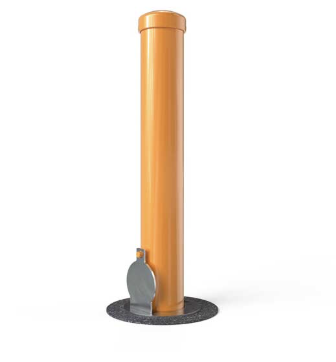
A hinged-top base keeps the receiver accessible by flipping up a hinged cover, letting crews remove or replace posts quickly without tools or loose plates. That accessibility speeds daily operations but raises maintenance considerations: hinges and seals should be specified for repeated use, and locking compatibility must match site access procedures to avoid field modifications.
Head Styles and Visual Compatibility
Round head styles are grouped into four configurations, each defined by cap shape, attachment method, and visual weight rather than a single design theme. These differences affect how the bollard reads in its surroundings and whether the head can be replaced independently of the post, which should be confirmed during specification.
Round Style 1 features a colonial-style ball cap with a decorative, traditional appearance and uses a bolt-on, interchangeable head. Round Style 2 uses a domed cap with a smooth rounded profile and is simple, functional, widely used, and bolt-on and interchangeable. Round Style 3 introduces a mid-profile rounded cap that sits visually between Styles 2 and 4 in height and shape and remains bolt-on and interchangeable. Round Style 4 uses a flat top cap with a modern, low-profile, utilitarian look and is often welded, making it typically non-interchangeable.
Locking Options and Control Level
Lock cylinders set into the receiver determine who can remove a bollard on site. Non-locking posts have no internal lock and depend on site procedures or barriers for control. Padlock-operated receivers accept a user-supplied padlock; specify shackle clearance and padlock dimensions. Keylock units use an integrated keyed lock and remove the need for external padlocks.
Padlock shackle clearance and keying choices affect replacement and daily operation, so record if locks should be keyed alike, keyed different, or supplied with master keying. Custom locking options such as electronic cores or proprietary cam locks are available by request and can match site policies, warranty terms, and service arrangements for ongoing access control.
Finish Selection and Site Visibility
Powder-coated steel is the standard finish for removable bollards, chosen for abrasion resistance and weather protection. Standard finish options include High-Reflective White, Safety Yellow, Black Semi-Gloss, Black Matte, Glossy Black, Silver, Roman Bronze Matte, Bengal Light Grey, Bengal Black, and Black Fine Texture. More than 80 additional powder coat colors and textures are available via the full color chart.
High-Reflective White and Safety Yellow increase day and night visibility for entry control, while matte and textured finishes reduce glare and hide scuffs. Record exact powder codes, finish texture, and any reflective requirements on drawings and purchase orders to prevent mismatches during procurement and installation.
Specifying for Real-World Use
Receiver locations follow the pavement grid and anchor-bolt layout, so drawing dimensions must match site measurements. Accurate specifications align product choice with daily operation: confirm heads are bolt-on and interchangeable or welded and non-interchangeable, pick a base type that matches removal frequency to limit labor, select locking to match who controls access, and list finishes from the full color chart.
Use a submittal checklist and one approval contact to avoid procurement errors, and supply powder-code samples with bolt-pattern and hinge details. Specify spare heads or receivers for quick swaps and choose keying (keyed alike, keyed different, or master) to fit site procedures moving forward.
Make deliberate configuration choices for base options, head styles, locking mechanisms, and finishes. Ordering removable bollards works best when each configuration decision is made carefully, and clear selection of base, head, lock, and finish supports reliable performance, clean installation, and consistent site results. Specify plate-covered or hinged-top receivers to match removal frequency, confirm bolt-on or welded heads, and record keying and lock style for access control. Document powder codes and finish texture on purchase orders and supply powder-code samples. Confirm attachment types, base details, keying, and powder codes before final approval. Name a single approval contact to reduce procurement errors.

0 Comments