
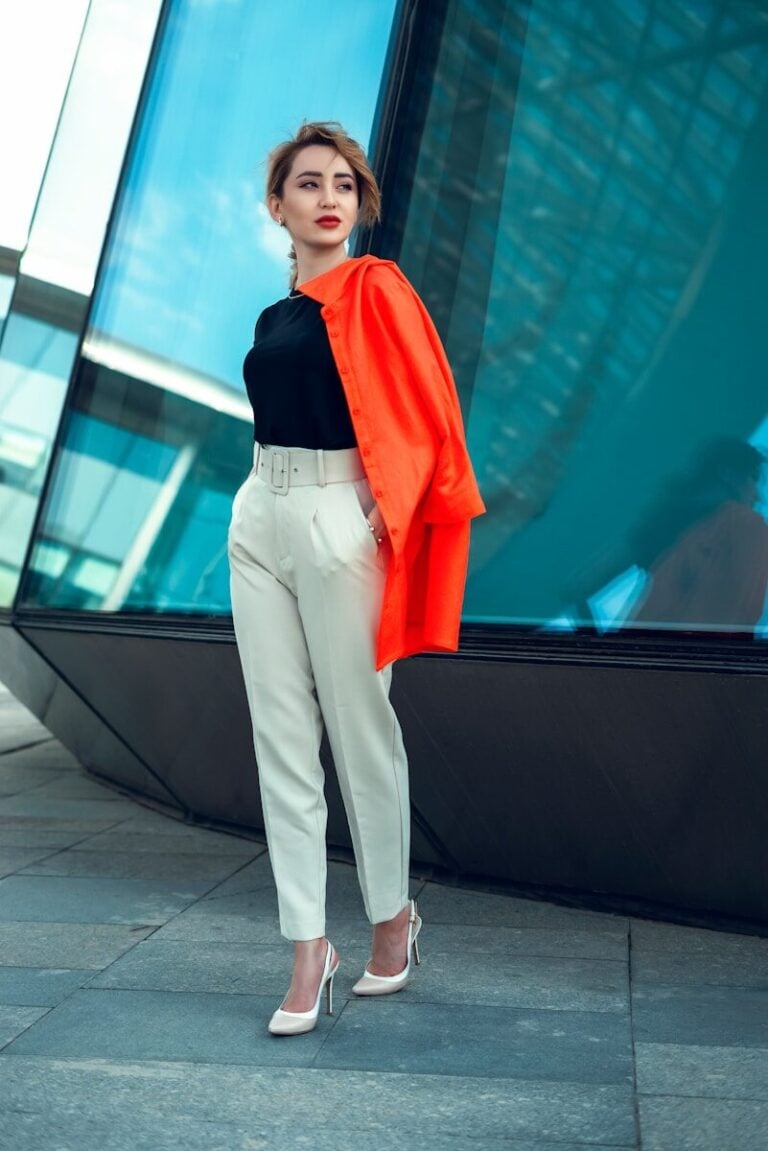

A paradigm shift in the world of fashion. The time when strict standards of beauty and exaggerated proportions of “anti-bodies” ruled is officially over. No more fashion that relies on artificial shaping; instead, it is all about harmony, natural athletic shape, and comfort.
To dress up in style does not mean to conceal your figure or try to force it into some standardized version. It means to learn about your skeleton and muscles and work with cuts, lines, and materials to highlight your body.
To elongate your body, to round out sharp lines, or to enhance certain proportions, you just need to learn several essential styling tricks, and you will completely transform the way your clothes fit. Here are 10 eternal and professional styling tricks to create a perfectly balanced silhouette.
1. The Power of Waist Definition
Achieving Balance for a Bottom Hourglass Body Shape, in the case that your proportions include a clear waist with wide hips that create a body that is slightly more curvy in its lower half than your upper half, then you have an inverted hourglass body type. The golden rule to keep in mind when dressing this particular body type is to always accentuate your narrowest area, your waistline.
In the event that you put on straight cut clothes or clothes that have no shape whatsoever, they will simply drape downwards either from your bust or hips and therefore disguise the narrowest part of your body which can lead to your body appearing bigger than what it really is.
Try These: Wrap dresses, high-waisted tailored pants, belted jackets.
Don’t Wear: Shift dresses, drop waistlines, loose boxy tops.
2. Use the “Rule of Thirds” to Elongate Your Frame
The general tendency of most people is to evenly split up their wardrobe, wearing tops and bottoms that are both equally long (1:1 ratio). This effectively bisects the body, making the torso and legs appear shorter.
In order to elongate the silhouette and make it more elegant, the Rule of Thirds is used. This is a rule according to which one should visually divide his/her body into thirds. It is necessary to strive for a 1:2 proportion – the upper part should be quite short (one third) and the lower part that occupies two thirds.
How to use it: Wear a tucked-in blouse under the high-waisted pants. The waist makes up one-third of the body, and long pants make up the other two-thirds.
3. Balance Proportions by Mixing Volumes
Wearing the perfect outfit requires a delicate balance of give-and-take. Wearing tight clothes throughout will mean you draw attention to any and all of your asymmetries. Conversely, wearing loose clothes from top to bottom means your body will become completely lost in the outfit.
The solution is quite simple: combine the solid with the flowing.
If you choose a flowy fabric that is designed to hang around the legs like palazzo pants or a straight skirt, then your upper garment must be snug and fitted. If you go for a heavy or boxy fabric as the material for your upper garment, then you must choose a sturdy fabric like jeans or pencil skirts.
4. Leverage Strategic Necklines to Frame Your Face
When it comes to harmonizing your shoulders and torso, the neckline plays an important role in this process. For those wanting to add length to a short neck and slim down a wide chest, open necklines can be quite helpful.
Vertical Lines: Vertical necklines create a line that will pull the eye down vertically.
Heart-shaped and Square Necklines: The necklines will draw attention to the collarbone and add the appearance of a broad chest.
Boat-Necked and Off-the-Shoulder Garments: Such types of lines will give an impression of wider shoulders in order to balance wide hips.
5. Pay Attention to Fabric Weight and Drape
The shape of your clothes depends solely on what they are made of. Hard, thick materials such as canvas, denim, or even hardwearing wool will result in tough, rigid shapes that do not flatter your body at all.
Search for materials that have just the right amount of shape and drape:
If You Have a Curvy Figure: Choose medium weight draping materials like silk, crepe, quality jersey, and fine cottons. Such materials will glide across your curves instead of clinging or creating a hard shape.
If You Wish to Create Structure: In case you need to create structure where none is there (in case of a straight or rectangular figure), use structured materials like tailored wool, gabardine, or thick linen.
6. Use Color Blocking and Monochromes Intentionally
Color can be effectively utilized in order to direct the eye movement of another person. If wearing a monochrome dress means wearing all colors of one kind from top to bottom, then such an outfit creates one uninterrupted line that makes a person look taller and sleeker because there are no interruptions created by strong contrasts of colors.
In case of wearing clothes of various colors, you should do the following:
To make others look up: wear a colorful, patterned, or light-colored top in combination with a dark, neutral bottom.
To create a visual balance: wear dark colors on those parts of your body that need to be visually minimized and leave colorful tones for your strong suits.
7. Master the Art of the “French Tuck”
It’s not always necessary to have the shirts rolled up and buttoned all the way to the top, particularly for a relaxed and casual look. A long shirt, however, can, if it hangs loose over the hips, spoil the look of the body proportions.
Enter into French tuck (or front tuck). Just fold in the front center of your shirt and tuck it into the front waistband; leave the sides and back untucked. It is an outline of your front waistline that shows your button or belt, but maintains your leg length and has a laid back look.
8. Pick Outwear with Integrated Architecture
When the jacket or coat is unbuttoned, it frames the entire outfit. Look for built-in shapes when selecting blazers, trenches or winter jackets.
A slightly tucked-in, or “u shaped” blazer will add a slimming effect on the ribcage, even if it is left open all the way down. For those who have an affinity for long coat, consider a classic trench coat with a tie belt. Tying the belt around the waist adds support to the coat to prevent it from sagging, particularly when it’s worn thickly in winter.
9. Avoid Clashing Hemlines
The end of the clothing is where the eye stops and looks. If you choose to go with hemlines that cross over the widest portion of the thigh or calf, they will make the area appear larger than it is.
Skirts and Dresses: Go to the narrowest part of your leg which is just above the knee, just below the knee or at the lower ankle.
Tops and Jackets: Do NOT have tops that taper off at the widest point of the hips. Rather, find tops that stop at the hip bone or longer tunics that do not cover the hip at all.
10. Start with the Right Foundation (Undergarments)
You may purchase the world’s most beautiful, costly gown but it will not fit properly if the underlying layers are not fit. An ill-fitting bra can make your bust line sag, which will make your bust line and overall proportion reduced by the distance between your chest and waist.
It is important to invest in a professional fitting of the bra as well as the undergarments being smooth and seamless. High quality contouring and functional underwear have become in demand all over the world as people are looking for both comfort and a streamlined look.
Shift in Modern Wardrobe Dynamics
It is evident that this move toward stylish yet confidence-building fashion is well-observed through the recent statistics within the fashion industry. The current consumer base is not pursuing extremely out-of-the-world runway fads anymore; instead, it is focusing on functional clothes.
| Metric / Market Indicator | 2026 Industry Status & Data | Strategic Impact on Personal Styling |
| Global Shapewear Market Valuation | Projected to hit $5.14 Billion (Fortune Business Insights) | Consumers are shifting toward comfortable, daily-wear contouring foundations rather than restrictive pieces. |
| Runway vs. Reality Representation | 97.1% of Spring/Summer runway looks remained straight-size (US 0-4) (Vogue Business) | Highlights the vital need for personal styling techniques; off-the-rack items require intentional styling to fit diverse bodies. |
| Consumer Buying Behavior | 67% of consumers actively support brands offering inclusive, body-liberation sizing | Wardrobes are built around personal body architecture rather than fast-fashion micro-trends. |
Frequently Asked Questions (FAQ)
How can I discover my own natural waistline?
This is the most constricted area of your body, between your rib cage and belly button, that is your natural waist. It’s simple to locate, simply bend to one side, and the crease in your body is your natural waist.
Which type of jeans would go well with a bottom hourglass shape?
High-waisted jeans with a tailored waistline would work best. Fitted styling that is tight around the waist without any back gap should work well (for instance, spandex cotton). Boot-cut, flare, and straight-leg jeans styles will suit full hips well.
Conclusion
Finally, rules of styling are guidelines to give you an understanding of the principles of visual balance and geometric symmetry. The true power lies in using these methods to boost your self-confidence. Whether you’re going for an edge in the office, a casual weekend look, or finding out how to highlight a Bottom Hourglass Body Shape, you just want your clothes to look good on you, not the other way round. Stick to good fabrics, respect what they have to offer you and wear what makes you feel like you.

0 Comments